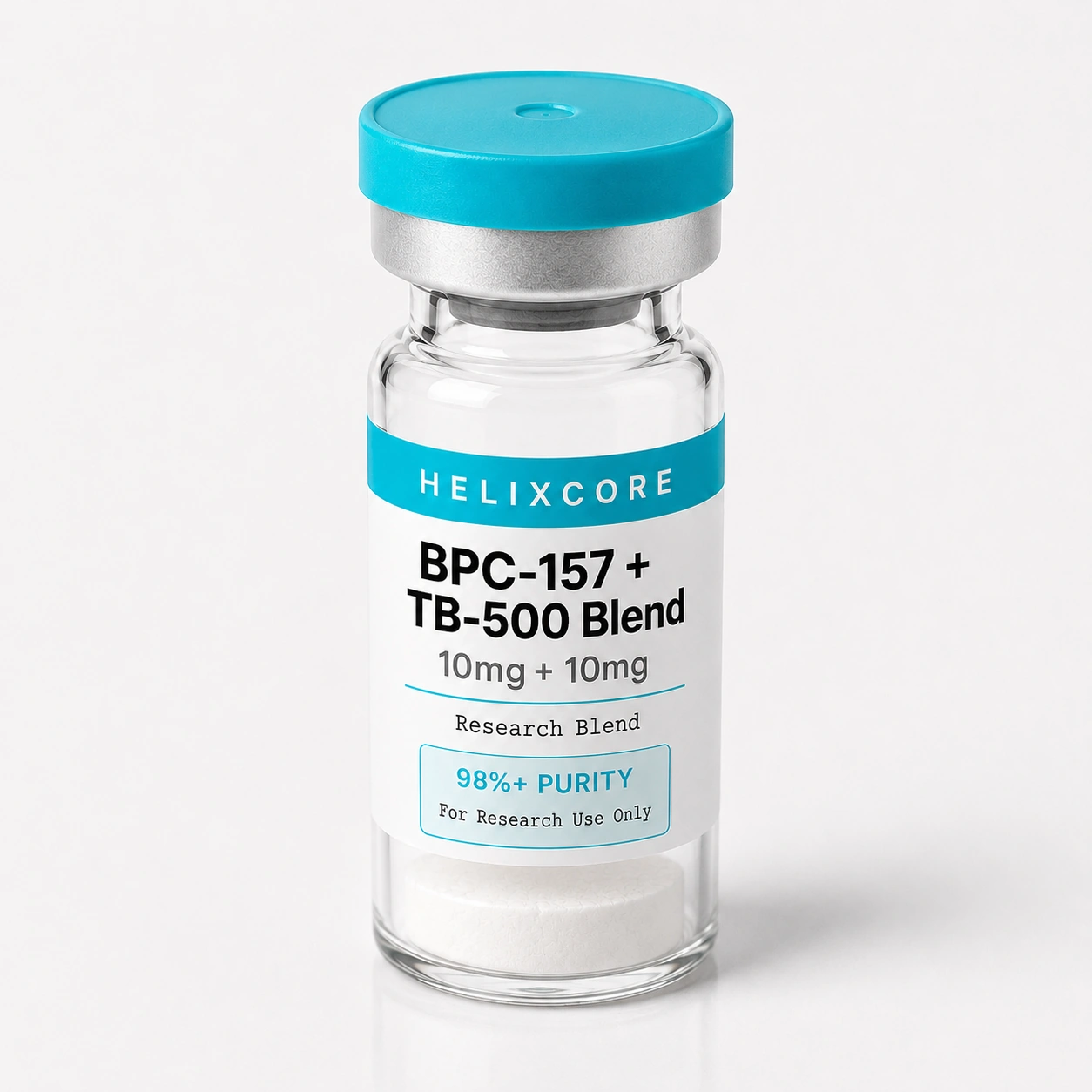
BPC-157 + TB-500 Research Blend
Pre-mixed research blend of BPC-157 and TB-500, 5mg of each in a single 10mg vial, supplied for in-vitro tissue-model and cell-migration research.
Purity
98%+ (per source specifications)
Form
Lyophilised Powder
Storage
-20°C lyophilised · store at 2–8°C once reconstituted
CAS Number
137525-51-0 (BPC-157) / 77591-33-4 (TB-500)
Mol. Weight
1419.53 / 889.0 g/mol
£35.99
Free UK delivery
About BPC-157 + TB-500 Research Blend
What it is
A single vial containing both BPC-157 and TB-500, prepared together so one reconstitution produces one solution. The two are frequently studied side by side in tissue-remodelling models because their proposed mechanisms are different rather than overlapping.
How it is understood to work
The pairing is of research interest precisely because the two act on separate parts of the same broad process. BPC-157 has been associated with vascular signalling and growth-factor receptor expression; TB-500 works on actin dynamics and therefore on the mechanics of cell movement. One concerns the supply route, the other the cells travelling along it.
What research has looked at
There is far less literature on the combination than on either component alone, and that is worth stating plainly. Most published work examines them separately. Anyone designing an experiment around the blend should treat the interaction as an open question rather than an established one.
Handling and storage
Reconstitute once and the solution contains both peptides at the stated ratio, so they cannot be dosed independently — if your protocol needs them varied separately, buy them separately. Storage as for the individual peptides: -20°C lyophilised, 2-8°C in solution, no repeated freeze-thaw.
Supplied for in-vitro laboratory research only. Nothing above describes a dose, a protocol, or a use in humans or animals, and none of these compounds is a licensed medicine in the UK.
Research Information
The BPC-157 + TB-500 Research Blend supplies both peptides in a single lyophilised vial for laboratory work that studies the two compounds together. They are frequently paired in published in-vitro work because their mechanisms are distinct rather than overlapping, and a pre-combined vial holds the ratio constant across a series of runs while removing a separate reconstitution step.
What is in the vial
10mg total: 5mg BPC-157 and 5mg TB-500, lyophilised.
BPC-157 is a synthetic 15 amino acid peptide derived from a fragment of a protein found in human gastric juice. It carries no chemical modifications.
- Sequence: Gly-Glu-Pro-Pro-Pro-Gly-Lys-Pro-Ala-Asp-Asp-Ala-Gly-Leu-Val
- Molecular weight: 1419.53 g/mol
- CAS: 137525-51-0
- Investigated in models of angiogenesis and growth factor signalling
TB-500 is a synthetic fragment of thymosin beta-4, a naturally occurring actin-sequestering protein.
- Molecular weight: 889.0 g/mol
- CAS: 77591-33-4
- Investigated in actin-binding and cell-migration models
Why the two are studied together
The published research on each compound addresses a different mechanism. BPC-157 work centres largely on angiogenic and growth factor pathways. TB-500 work centres on actin sequestration and cell motility. Because those are separate routes rather than two versions of the same one, experimental designs often include both so that the contribution of each pathway can be observed within a single model rather than across separate runs.
A combined preparation is used where a protocol calls for a fixed 1:1 ratio held constant across a series, or where the number of reconstitution steps is itself a source of variance.
For a fuller mechanistic comparison of the two compounds, see BPC-157 vs TB-500: what is the research difference?.
Reconstitution
Supplied lyophilised and reconstituted before use, typically with bacteriostatic water. Add the diluent slowly against the wall of the vial rather than directly onto the powder, and allow it to dissolve without shaking. Both components go into solution together, so the resulting concentration applies to the blend as a whole.
See Reconstituting lyophilised peptides for the full method and a worked concentration example.
Analytical verification
Identity and purity are confirmed at source by high-performance liquid chromatography (HPLC) and mass spectrometry.
See Reading a certificate of analysis for how to interpret the figures on a COA.
Storage and handling
Store lyophilised at -20°C, protected from light. Once reconstituted, keep refrigerated and use within the window appropriate to the protocol. Avoid repeated freeze-thaw cycles, which degrade peptides in solution.
See Storing research peptides for handling detail.
Research use only
Supplied strictly for in-vitro laboratory research. Not for human or veterinary use. Not a medicine, and not supplied for any diagnostic or therapeutic purpose.
Batch documentation
Each listed batch includes its supplied certificate of analysis. Published figures are reported per source specifications.
UK dispatch
UK-stocked. Orders placed before 2pm dispatch the same business day via Royal Mail Tracked 24. Free UK shipping on every order. We ship to UK addresses only.