Updated
Storing research peptides: temperature, shelf life and handling
A practical laboratory workflow for receiving, storing and documenting research peptides, using conditions and holding periods supported for the specific material.
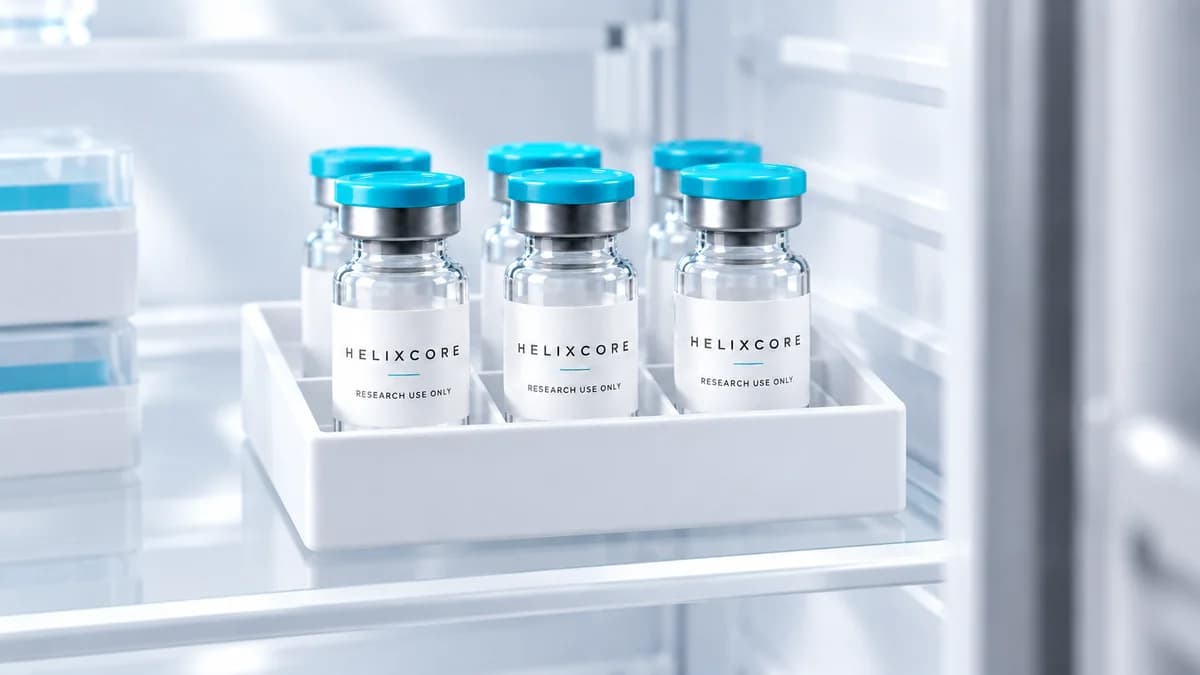
Good storage begins with the documentation for the specific material. A peptide's sequence, formulation, physical state and intended experiment affect how it should be handled. This guide sets out a practical record-keeping and handling workflow; it does not assign a universal shelf life.
For how to evaluate a stability claim, see why a storage temperature is only part of the story.
On receipt: identify, inspect and record
Check the product and batch identifiers against the supplied information. Record the receipt date, the condition of the packaging and any known delivery issue. Keep the certificate and product instructions with the material's laboratory record.
Use the documented storage conditions. If instructions are missing or inconsistent, seek clarification rather than copying a temperature or expiry period from a different compound.
Keep dry material protected
Lyophilised material and a prepared solution should not be assumed to behave the same way. For dry peptides, moisture exposure is a particular handling consideration.
Bachem's peptide handling guidance recommends letting cold samples equilibrate appropriately before opening, limiting exposure during weighing and resealing promptly. Apply the product instructions and your laboratory procedure to the material being handled.
Use a suitable closed container and follow any specified protection from light. Record the storage location and temperature. A general recommendation for cold storage does not establish that every compound will remain acceptable for a fixed number of months or years.
Plan a solution for the experiment
Choose the solvent, concentration, container and storage conditions using the compound's documentation and the requirements of the assay. Bacteriostatic water is not a universal solvent or a substitute for a validated laboratory procedure.
Do not assume all peptide solutions should be refrigerated, that all should be frozen, or that they share a two-to-four-week lifetime. Use a supported holding period for the particular preparation. If that evidence is unavailable, record the uncertainty and seek appropriate technical guidance.
Reduce unnecessary repeated handling
Where the material and protocol support it, aliquoting can reduce repeated access to a stock solution. Bachem discusses aliquoting in its handling guidance, but the appropriate storage conditions still depend on the preparation.
Label each aliquot so it can be traced to the original batch and preparation record. Useful fields include the preparation date, solvent, concentration, storage conditions and any validated use-by limit. Do not assign an expiry solely from a generic rule of thumb.
Respond to a change or excursion
Document a temperature excursion, damaged closure or unexpected appearance. Compare the observations with what is expected for that particular compound; a clear, colourless solution is not a universal requirement or a proof of integrity.
Visual inspection cannot establish chemical stability. Where needed, seek a material-specific analytical assessment. An original certificate does not measure what happened during subsequent storage.
Keep the record useful
The practical aim is a traceable history: what arrived, where it was stored, how it was prepared and what happened before the experiment. Review that history alongside the supplied batch documentation. All HelixCore materials are supplied for in-vitro laboratory research only.