BPC-157 vs TB-500: what's the research difference?
A structural and mechanistic comparison of the two most-studied tissue research peptides. How they actually differ, where the published research focuses, and when to use each in in-vitro experimental design.
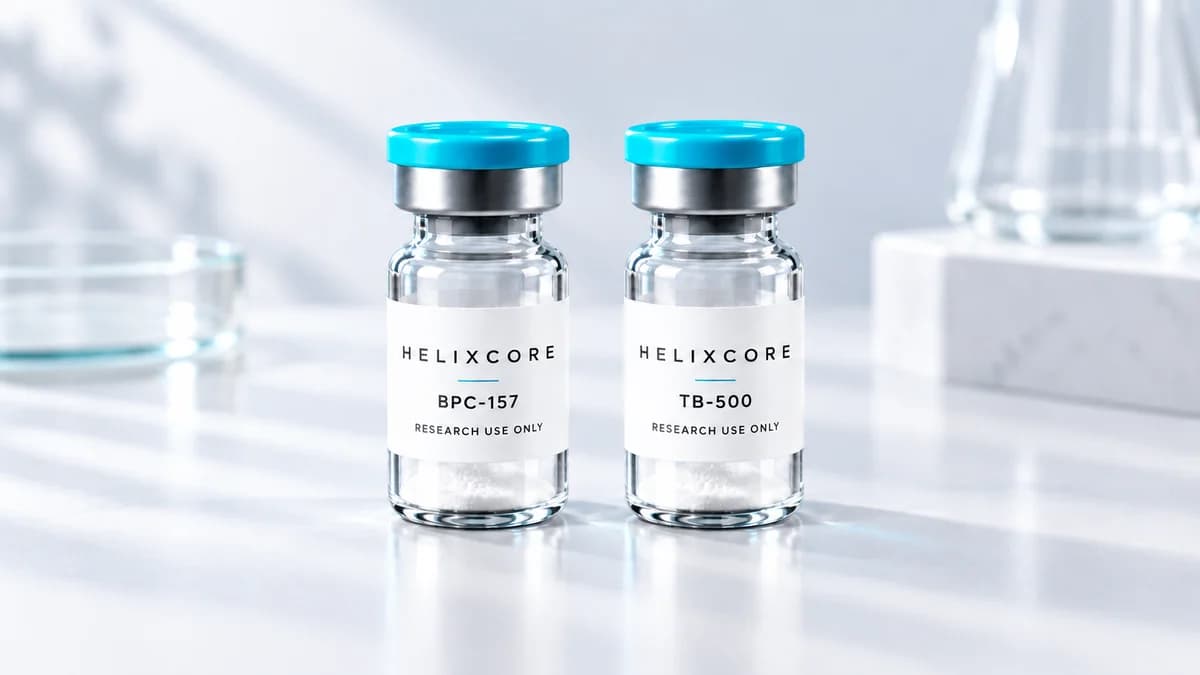
BPC-157 and TB-500 are the two most-studied peptides in tissue research. They often appear together in published in-vitro work, in catalogue listings, and in researcher questions. They're also commonly confused: both are studied for cell-model tissue research, both come from the same general supply channels, and both get described loosely as "recovery peptides".
Structurally and mechanistically, they're very different. This article walks through what each one actually is, how they're studied, what the published research focuses on, and where the differences matter for in-vitro experimental design.
The structural starting point
BPC-157 is a synthetic 15-amino-acid peptide derived from a fragment of a protein found in human gastric juice. Its sequence:
Gly-Glu-Pro-Pro-Pro-Gly-Lys-Pro-Ala-Asp-Asp-Ala-Gly-Leu-Val
It carries no chemical modifications — it's a straightforward linear peptide. Molecular weight 1419.53 g/mol. CAS 137525-51-0.
TB-500 is the synthetic version of thymosin β-4, a 43-amino acid peptide naturally present in most mammalian cells. The TB-500 commonly sold for research is biologically identical to native thymosin β-4. Its sequence is significantly longer and structurally more complex than BPC-157. Molecular weight ~4963 g/mol — over three times the size.
The size difference matters experimentally. TB-500 behaves like a small protein in solution: more sensitive to handling, slightly more challenging to keep cleanly in solution at lower concentrations, and with somewhat different cell-uptake characteristics.
What they're studied for — the mechanisms
BPC-157 — gut-derived, broadly studied
Published preclinical work on BPC-157 has focused on:
- Nitric oxide signalling — modulation of endothelial and inducible nitric oxide synthase pathways
- Growth factor receptor expression — particularly VEGFR2, the receptor for vascular endothelial growth factor (angiogenesis pathway)
- Tendon fibroblast research — in-vitro work on isolated tendon cells showing increased migration and matrix production
- Gastrointestinal protection — its original area of study, covering NSAID-induced injury models, ulcer healing, and gut motility
- Gut-brain axis — newer work exploring central effects via enteric signalling
TB-500 — actin-binding, cell migration
Thymosin β-4 (and therefore TB-500) has a well-characterised primary mechanism: it's an actin-sequestering protein. Inside cells, it binds monomeric G-actin and prevents it polymerising into F-actin filaments until the cell needs it. This regulates the actin pool that's available for cell-shape changes and movement.
Downstream of this primary mechanism, published research on TB-500 has examined:
- Cell migration — particularly in cell-migration assays of endothelial cells, keratinocytes, and stem cells
- Angiogenesis — endothelial tube formation in cell models
- Inflammatory modulation — effects on pro-inflammatory cytokine expression in immune cell lines
- Stem cell recruitment — chemotaxis of progenitor cells in response to thymosin β-4 in cell-culture studies
So where do they overlap?
Both compounds are studied in models of tissue repair, both have effects on angiogenesis-adjacent pathways, and both are commonly used in tendon-related cell research. That's why they often appear together in researcher catalogues and in "combined-mechanism" blend products.
But the mechanisms are different at the molecular level. BPC-157's mode of action is still debated — the candidates so far are all indirect (nitric oxide, growth factor receptor expression). TB-500 has a known primary mechanism (actin binding) with well-characterised downstream effects.
For researchers designing in-vitro experiments, the practical implication is that you usually need both if you want to dissect "general tissue repair signalling" vs "actin-dependent cell migration". They're complementary research tools, not redundant ones.
The combined-mechanism blend
Researchers running combined-mechanism experiments often use both peptides together. The BPC-157 + TB-500 Research Blend is a pre-mixed single-vial preparation containing both compounds at standard 5mg + 5mg ratios — supplied for in-vitro work where the researcher wants both pathway probes available without separate reconstitution.
Specifications and handling
Both compounds are supplied as lyophilised acetate salt vials. Standard sizes and treatments:
- BPC-157 — 5mg or 10mg vials. 98%+ purity per source specifications. Reconstitutes cleanly in bacteriostatic water. Stable at −20°C lyophilised, 2–8°C reconstituted (use within ~4 weeks).
- TB-500 — 5mg or 10mg vials. 98%+ purity per source specifications. Reconstitutes cleanly in bacteriostatic water but slightly more sensitive to handling than BPC-157 due to its larger size — avoid vortexing.
See our guide on reconstituting lyophilised peptides for the standard technique.
The literature — what's published vs what's claimed
Both compounds are subject to significant "research-claim inflation" in the wider biohacking and supplement discourse — claims that go well beyond what the preclinical literature supports.
BPC-157's actual published research is dominated by rodent studies from a small number of European laboratories, with patchy independent replication. See our BPC-157 research overview for the state of the literature.
TB-500's underlying compound (thymosin β-4) has a much longer and broader peer-reviewed literature, including some early human clinical work in chronic wound and corneal indications. The synthetic TB-500 sold for research is the same molecule.
Which one for what kind of research
Reasonable rules of thumb for in-vitro experimental design:
- Studying actin dynamics, cell migration, chemotaxis — TB-500 is the more directly relevant probe. The actin-binding mechanism is the primary effect.
- Studying angiogenesis pathway activation broadly — both are commonly used. BPC-157 may upregulate VEGFR2; TB-500 affects endothelial migration. Different ends of the same pathway.
- Studying inflammatory signalling — TB-500 has the more characterised inflammatory modulation work.
- Studying gastrointestinal cell-line response — BPC-157 is the better-characterised compound in this area, as that's its original area of study.
- Studying combined-mechanism tissue repair — both, often as a blend.
Bottom line
BPC-157 and TB-500 are commonly grouped together because they overlap in the same broad research area, but they are mechanistically distinct compounds. BPC-157 is a small, gut-derived synthetic peptide with a still-debated mechanism and a focused preclinical literature. TB-500 is a longer actin-binding peptide identical to native thymosin β-4 with a clearer primary mechanism and broader published research base.
Both are stocked at HelixCore in 5mg and 10mg vials, 98%+ purity (per source specifications). Supplied batch certificates are published on the product pages. View BPC-157 · View TB-500 · View the combined blend.