How to reconstitute lyophilised research peptides — the proper way
The standard lab approach to reconstituting freeze-dried peptides: choosing solvent, the step-by-step technique, storage after reconstitution, and the most common mistakes that waste material.
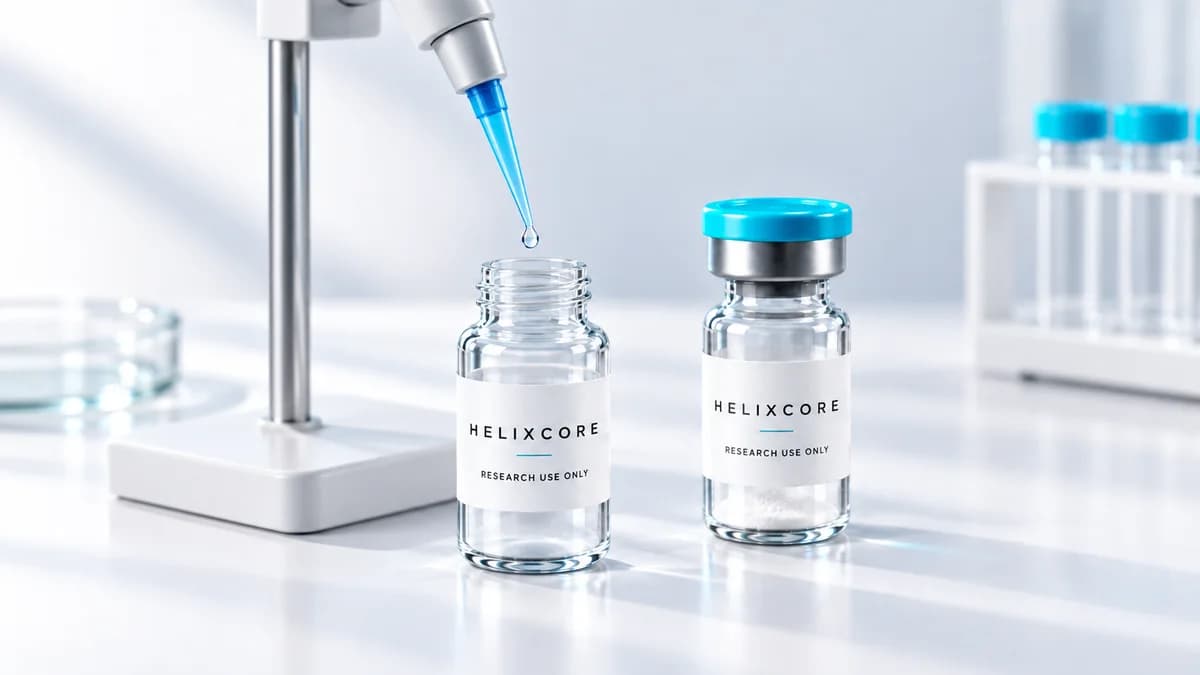
Reconstituting a lyophilised research peptide isn't complicated, but doing it wrong is one of the most common ways researchers waste expensive material. The wrong solvent, the wrong technique, or the wrong storage after reconstitution can degrade a peptide within hours of the vial being opened.
This guide covers the standard lab approach to reconstituting freeze-dried peptides for in-vitro work — which solvent to use, in what volume, how to handle the vial, and what to do with it afterward. It is framed for laboratory research use only and assumes you are working in an appropriate setting.
Why peptides are supplied as lyophilised powder
Lyophilisation — freeze-drying under vacuum — removes water from the peptide and leaves behind a stable solid. In this form, most research peptides are stable for years at −20°C in a sealed vial. Once dissolved in any aqueous solvent, that stability window collapses to days or weeks depending on the compound.
The implication: keep peptides lyophilised until you actually need them in solution. Reconstitute the volume you need, when you need it.
Choosing the right solvent
Most lyophilised research peptides dissolve cleanly in bacteriostatic water — sterile water containing 0.9% benzyl alcohol as a preservative. The preservative inhibits bacterial growth, which means a single vial can be punctured multiple times across a research project without contamination.
Some peptides are more hydrophobic and don't dissolve fully in neutral bacteriostatic water. For these, the standard lab step-up is dilute acetic acid:
- 0.6% acetic acid solution — the standard mid-strength option. Works for moderately hydrophobic peptides where neutral water is sluggish: GHK-Cu, PT-141, MT-1, KPV, Adipotide.
- 1% acetic acid solution — the step-up for highly hydrophobic peptides that don't dissolve in 0.6%: LL-37, Thymosin α-1, Thymalin, long Khavinson bioregulator chains.
The standard lab progression: try bacteriostatic water first. If after 5 minutes of gentle swirling there's undissolved material, step up to 0.6% acetic acid. If that's still not enough, 1%. Don't go beyond 1% without consulting the source datasheet — at higher concentrations the acetic acid can begin to affect sensitive peptide bonds.
Step-by-step: the technique
The mechanics are the same regardless of solvent.
1. Bring the vial to room temperature
Take the peptide vial out of the freezer and leave it sealed on the benchtop for 15–20 minutes. Cold glass plus humidity equals condensation inside the vial when you remove the cap, which introduces water that wasn't supposed to be there. This step is small and people skip it constantly.
2. Calculate your target concentration
Decide what working concentration you want in solution. Typical lab concentrations for in-vitro work are 1–5 mg/mL but it depends on the experiment. Example: 5mg peptide in 2.5mL solvent gives a 2 mg/mL stock.
3. Inject the solvent slowly, down the glass wall
Use a sterile syringe to draw the calculated solvent volume. Insert the needle through the rubber stopper at an angle and dispense the solvent slowly, aiming for the inside glass wall rather than directly onto the peptide pellet. Direct impact can shock-denature some sequences.
4. Do not shake. Swirl gently.
Vortexing and aggressive shaking introduce shear forces that can break disulfide bonds in cyclic peptides and degrade longer sequences. Hold the vial between your fingers and roll it gently for a minute or two. If material isn't fully in solution after a few minutes of swirling, leave it on the bench for 10–15 minutes — most peptides finish dissolving with time, not force.
5. Check for full dissolution
Hold the vial up to a light. A properly reconstituted peptide is clear and colourless (with exceptions: GHK-Cu solutions are characteristically blue because of the copper, MOTS-c can show a faint amber tint). Any visible particulate matter means it isn't fully in solution — give it more time, or step up the solvent.
After reconstitution: storage
Once a vial is reconstituted, it's a fundamentally different stability profile from the lyophilised form. Standard lab practice:
- Store at 2–8°C — a standard lab fridge. Bacteriostatic water-reconstituted peptides are typically stable here for 2–4 weeks; acetic acid-reconstituted peptides shorter (2–3 weeks).
- Protect from light — many peptides are photosensitive. The brown glass vial helps but storing in a closed drawer or fridge bin is the cleaner approach.
- Avoid freeze–thaw cycles — every time a reconstituted peptide freezes and thaws, you lose some active material. If you need long storage of a stock solution, aliquot into smaller volumes first and freeze each aliquot separately.
Common reconstitution mistakes
Using non-bacteriostatic water
Plain sterile water (without preservative) is fine for single-use, but the moment you puncture a vial twice you risk contamination. For multi-use research protocols, always reach for bacteriostatic water unless you have a specific reason not to.
Shaking
Already covered above but worth repeating. Shear stress is a real degradation pathway for peptides. Gentle swirling only.
Reconstituting the whole vial when you only need part
Once reconstituted, the clock starts. If your protocol only needs 1mg out of a 5mg vial, consider whether you can use a smaller vial size, or whether the remaining 4mg will be used within the stability window before degradation.
Wrong solvent volume calculations
It's easy to confuse total peptide mass with effective concentration. Always re-check your maths before injecting solvent. Mistakes here are unrecoverable — you can't un-dissolve a peptide.
Solvent supply
HelixCore stocks the three lab-standard reconstitution solvents for UK researchers:
- Bacteriostatic Water (10mL multi-dose vial) — your default for most peptide reconstitution.
- Acetic Acid 0.6% Solution — the mid-strength step-up for peptides that don't fully dissolve in neutral water.
- Acetic Acid 1% Solution — the stronger backup for highly hydrophobic compounds.
All three are USP-grade, UK-stocked, and dispatched same business day on orders placed before 2pm.
Bottom line
Reconstitution is one of those tasks where the difference between best practice and shortcuts shows up weeks later as inconsistent experimental results. Bring the vial to room temperature, pick the right solvent, dispense slowly, swirl rather than shake, refrigerate after, and aliquot if you need extended storage. Five small steps, and your stock solution behaves the way the published protocol expected it to.