PT-141 (Bremelanotide): melanocortin pharmacology explained
PT-141 is one of the few research-catalogue compounds whose parent molecule became an approved medicine. An overview of its MC3R/MC4R melanocortin mechanism, its relationship to Melanotan II, and its unusually clear regulatory picture.
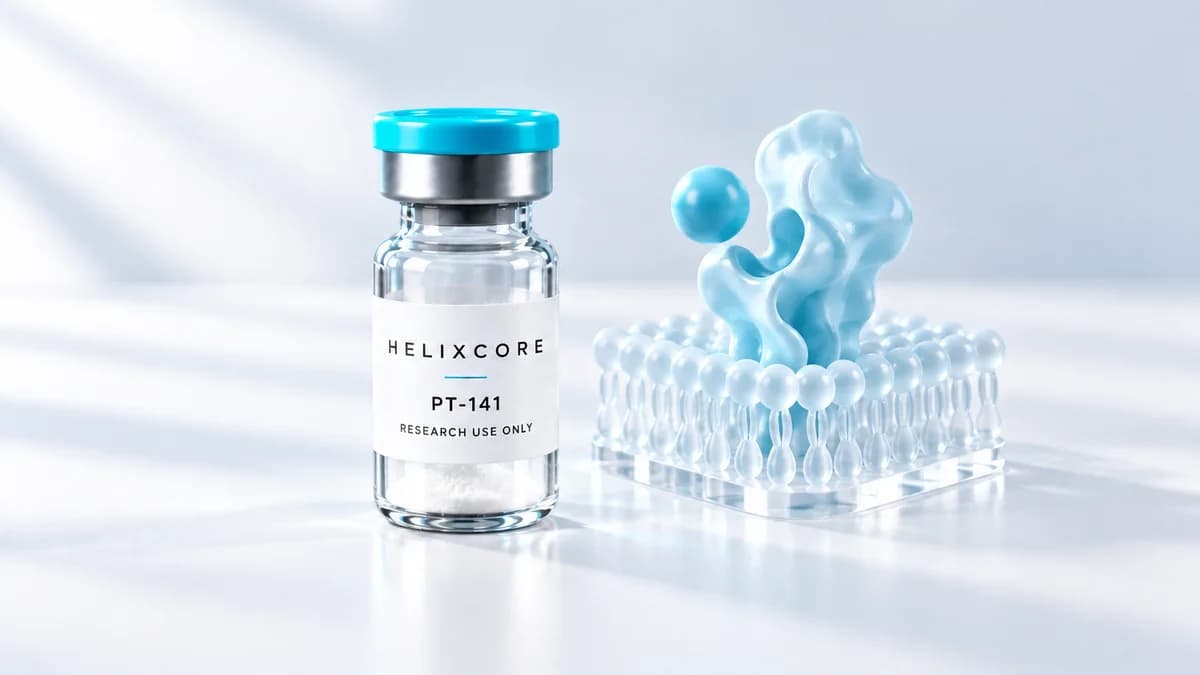
Almost everything in a research-peptide catalogue sits in the same evidential position: preclinical work, some cell culture, some animals, no regulator has ever assessed it. PT-141 is the exception. Its parent molecule went through the full development pipeline and emerged as an approved medicine. That makes it a useful reference point for what the rest of the catalogue has not done.
What it is
PT-141, generic name bremelanotide, is a cyclic heptapeptide with a molecular weight of approximately 1,025 g/mol. It is a melanocortin receptor agonist, and it exists because of what researchers found while working on a different molecule entirely.
Its predecessor is Melanotan II, a synthetic analogue of alpha-melanocyte-stimulating hormone developed at the University of Arizona in the 1980s as a way of inducing pigmentation without ultraviolet exposure. During that work an effect on sexual arousal was observed that was unrelated to the pigmentation target. PT-141 is a metabolite of Melanotan II, isolated and developed specifically to pursue that second effect while shedding the first.
The mechanistic picture
Receptor selectivity
The melanocortin system comprises five receptor subtypes. MC1R is the pigmentation receptor. MC2R responds to ACTH in the adrenal cortex. MC3R and MC4R are expressed largely in the central nervous system and are involved in energy homeostasis and sexual function. MC5R has roles in exocrine tissue.
Melanotan II is a broad agonist across MC1R, MC3R, MC4R and MC5R, which is why pigmentation is such a prominent feature of it. PT-141 shifts the profile towards MC3R and MC4R with substantially reduced MC1R activity. That selectivity is the whole design rationale: the same central pathway, much less of the peripheral pigmentation effect.
A central mechanism, not a vascular one
The pharmacologically interesting point is where PT-141 acts. Phosphodiesterase type 5 inhibitors, the familiar drug class in this area, work peripherally on smooth muscle and blood flow. PT-141 acts centrally, on melanocortin receptors in the hypothalamus and related structures, upstream of the vascular response. Two entirely different mechanisms addressing overlapping territory, which is why the compound was pursued at all.
The blood pressure problem
Development was not smooth. An intranasal formulation was taken into trials and abandoned after transient increases in blood pressure were observed. The programme continued with subcutaneous administration at lower exposure, and the cardiovascular signal remains a documented feature of the pharmacology rather than a historical footnote. Anyone reading the literature should expect to encounter it.
The regulatory picture
Bremelanotide was approved by the United States Food and Drug Administration in June 2019, marketed as Vyleesi, for hypoactive sexual desire disorder in premenopausal women. It is supplied as a subcutaneous autoinjector at a defined strength.
This needs stating carefully, because it is the single most misread fact about the compound. An approved medicine is a specific manufactured preparation, at a specified strength, in a specified device, assessed by a regulator for a specified population and indication. Research- grade PT-141 is none of those things. It is a lyophilised research chemical. The existence of an approved product containing the same active molecule says something useful about the pharmacology and nothing whatsoever about the research material, which has not been assessed by any regulator and is not supplied for use in humans or animals.
What has been demonstrated
- Selective agonism at MC3R and MC4R with reduced MC1R activity relative to Melanotan II.
- A centrally mediated mechanism, distinct from peripheral vasodilator pharmacology.
- Efficacy sufficient for regulatory approval of the parent molecule in one indication.
- A characterised, dose-related transient effect on blood pressure.
- Reduced pigmentation response compared with its parent compound, as designed.
Specifications you will see
PT-141 is typically supplied lyophilised in 10mg vials at 98%+ purity. As a cyclic peptide it is reasonably stable in the freeze-dried state. Reconstitute in bacteriostatic water, keep it refrigerated afterwards, and avoid repeated freeze-thaw cycles. See the reconstitution guide, the storage guide, and the PT-141 reconstitution calculator.
Bottom line
PT-141 is the best-characterised compound in this catalogue by a wide margin, because a regulator has actually examined the molecule. Its melanocortin pharmacology is well defined, its development history is documented including the parts that went wrong, and its relationship to Melanotan II is a clean example of structure-activity work narrowing a broad agonist into a selective one. That clarity is genuinely unusual here, and it is also exactly why the distinction between an approved pharmaceutical product and a research chemical deserves more care with this compound than with any other.
HelixCore stocks PT-141 at 98%+ purity per source specifications. The supplied batch certificate is published on the product page. UK stock, Royal Mail Tracked 24 dispatch, supplied strictly for in-vitro laboratory research use only, not for human or veterinary use.