Epitalon and the bioregulator peptides: claims versus evidence
A careful look at Epitalon — the tetrapeptide bioregulator, its telomerase and pineal research, the research lineage it comes from, and why its extraordinary claims need the ordinary standard of independent replication.
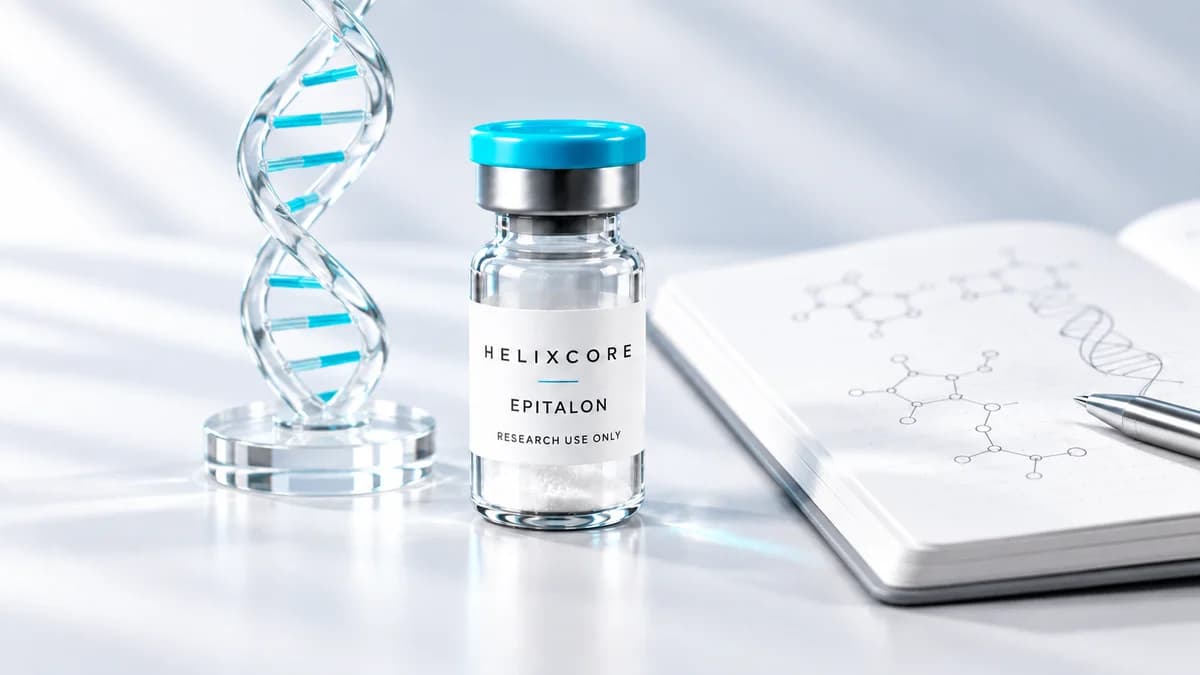
Epitalon occupies an awkward position in the research-peptide catalogue. The claims attached to it are among the largest made for any small peptide: telomerase activation, telomere elongation, extended lifespan in animals. The evidence behind those claims is unusually concentrated in a single research lineage. Both of those things are true at once, and any honest overview has to hold them together rather than pick one.
What it is
Epitalon, also written Epithalon or Epithalone, is a tetrapeptide: alanyl-glutamyl-aspartyl- glycine, usually abbreviated AEDG. Its molecular weight is about 390 g/mol, which makes it one of the smallest molecules in the catalogue. It is a synthetic analogue of epithalamin, a polypeptide preparation originally extracted from the pineal gland of cattle.
It is the best known member of a group described as peptide bioregulators: very short peptides, typically two to four residues, proposed to act as tissue-specific regulators of gene expression. Others in the same family appear in catalogues as thymalin, prostamax and similar preparations.
Where the research comes from
This is the part that matters most for interpreting anything else, so it belongs near the top rather than buried at the bottom.
The great majority of Epitalon research originates with Vladimir Khavinson and colleagues at the St Petersburg Institute of Bioregulation and Gerontology, work that traces back to Soviet military and gerontological research programmes beginning in the 1970s. A large body of publications exists. A much smaller body of independent replication exists.
That is not an accusation, and a finding is not wrong because of who produced it. But the ordinary standard in biology is that a striking result becomes established when unconnected groups reproduce it, and for Epitalon that step is substantially incomplete. Much of the primary literature is also in Russian-language journals or venues with limited indexing, which raises the practical cost of scrutiny for most readers.
The mechanistic picture
Telomerase and telomeres
The central claim is that Epitalon induces telomerase activity, the enzyme that extends the repetitive telomeric sequences capping chromosomes, and that this produces telomere elongation in cultured human somatic cells. Telomere shortening is one of the recognised hallmarks of cellular ageing, so a small peptide that reverses it would be a significant finding.
It is worth noting that telomerase activation is not straightforwardly desirable in a biological sense. Most somatic cells suppress telomerase deliberately, and its reactivation is a common feature of tumour cells. Any serious research programme in this area treats that as a central question rather than a footnote.
Gene expression and the bioregulator model
The broader theoretical claim is that very short peptides can enter the nucleus and interact directly with DNA or chromatin in a sequence-influenced way, modulating transcription. This is the mechanistic foundation of the whole bioregulator concept. It remains contested. The proposal is chemically specific enough to be testable, which is a point in its favour, and the testing has been narrower than the claim warrants.
Pineal and circadian work
Because epithalamin came from pineal tissue, a strand of the research examines melatonin rhythms and circadian regulation, particularly in aged animals. This work is more modest in its claims and correspondingly less contested than the telomerase material.
What has been reported
- Telomerase induction and telomere elongation in cultured human fibroblasts.
- Extended median and maximum lifespan in rodent studies from the originating group.
- Restoration of melatonin rhythm parameters in aged animals.
- Antioxidant-associated and immune-associated effects across various in-vitro systems.
What has not happened
There is no substantial independent replication of the telomerase and lifespan findings by groups unconnected to the original programme. There are no large, well-controlled, registered human trials of the kind that would settle the question. Epitalon is not an approved medicine in the United Kingdom, the European Union or the United States.
The honest summary is that Epitalon is a compound with an unusually large claim and an unusually narrow evidential base. That combination is exactly what independent replication exists to resolve, and it has not yet done so.
Specifications you will see
Epitalon is commonly supplied lyophilised in 10mg or 20mg vials at 98%+ purity. As a short, highly polar tetrapeptide it dissolves readily in bacteriostatic water. Standard handling applies: keep it cold, keep it dry until reconstitution, and avoid repeated freeze-thaw cycles. See the reconstitution guide, the storage guide, and the Epitalon reconstitution calculator.
Bottom line
Epitalon is a well-defined chemical entity with a coherent theoretical framework behind it and a research history that is genuinely interesting. It is also the clearest case in this catalogue of a compound whose reputation runs ahead of its independently verified evidence. As a research tool it is legitimate and inexpensive. As a settled scientific story it is not, and anyone citing the telomerase results should know how few groups have produced them.
HelixCore stocks Epitalon at 98%+ purity per source specifications. The supplied batch certificate is published on the product page. UK stock, Royal Mail Tracked 24 dispatch, supplied strictly for in-vitro laboratory research use only, not for human or veterinary use.