Sermorelin, CJC-1295, Tesamorelin: GHRH analogues compared
The four most-studied GHRH analogues side by side — Sermorelin, CJC-1295 No DAC, CJC-1295 With DAC, and Tesamorelin. Structure, half-life, and which is the right research tool for what.
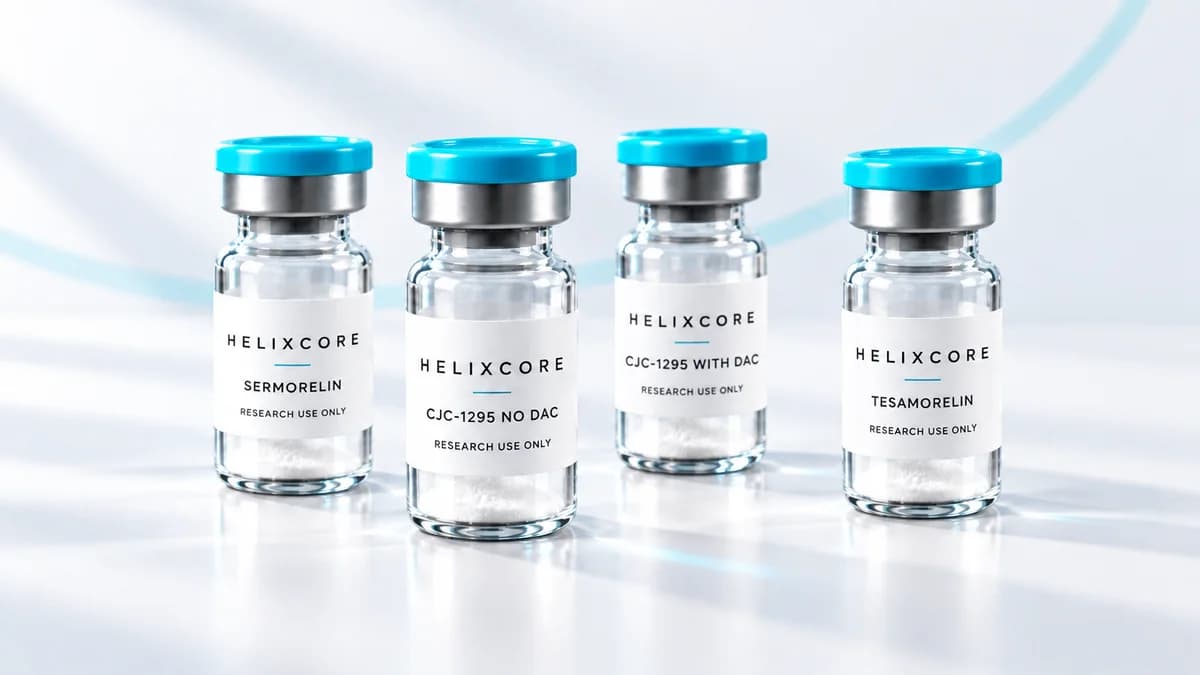
The growth hormone releasing hormone (GHRH) receptor research field centres on three base compounds — Sermorelin, CJC-1295, and Tesamorelin — but CJC-1295 is supplied in two distinct variants (with and without DAC), so researchers will actually encounter four separate GHRH analogues in catalogues. They all target the same receptor but with very different structural properties, half-lives, and research applications.
This article compares all four, focused on what they actually are, what published research focuses on with each, and when one is the appropriate research tool over another for in-vitro work.
The receptor
Native GHRH is a 44-amino-acid peptide released from the hypothalamus that binds the growth hormone releasing hormone receptor (GHRHR) on pituitary somatotroph cells. Binding triggers a cAMP-dependent signalling cascade that results in growth hormone release from those cells. The receptor is a class B G-protein-coupled receptor — relevant because it shares mechanistic characteristics with secretin, glucagon, and parathyroid hormone receptors.
For researchers studying this pathway, native GHRH itself isn't usually the most useful probe: its half-life is short (minutes), and it's relatively expensive to synthesise full-length. The four analogues each solve different parts of that problem.
Sermorelin — the minimal active sequence
Sermorelin is a 29-amino-acid peptide representing the N-terminal active fragment of native GHRH (GHRH 1-29). All the binding affinity of full-length GHRH lives in the first 29 residues — Sermorelin is effectively "native GHRH minus the inactive tail".
For in-vitro research, this makes Sermorelin a useful reference compound for studying GHRHR binding and downstream cAMP signalling. It binds the receptor with affinity comparable to full-length GHRH, but it's shorter and easier to work with. Most published cell-model research on GHRHR uses Sermorelin or Sermorelin-like fragments rather than full GHRH.
Half-life characteristics: short, comparable to native GHRH. Useful when researchers want to study acute GHRHR activation in pituitary cell lines without the receptor being chronically occupied.
Sermorelin is the closest research-tool analogue to the native receptor signal.
CJC-1295 (No DAC) — the reference modified analogue
CJC-1295 without DAC is a 30-amino-acid GHRH analogue with several amino-acid substitutions designed to make the molecule more stable than native GHRH or Sermorelin, but without the Drug Affinity Complex (DAC) modification (more on that below).
The substitutions modify the residues that native GHRH uses to bind to plasma proteases — making the synthetic version more resistant to enzymatic cleavage in cell-culture media and serum. The receptor binding affinity is preserved.
For in-vitro research, CJC-1295 (No DAC) is useful when researchers want Sermorelin-like signalling but with a more stable peptide that survives longer in cell-culture conditions. It's a reference compound for comparison against the DAC-modified variant.
CJC-1295 With DAC — the extended-action version
CJC-1295 with DAC is the version that includes the Drug Affinity Complex modification — a small molecule conjugated to the peptide that binds covalently to serum albumin once the peptide enters the bloodstream.
The result is a dramatic half-life extension. Native GHRH has a half-life measured in minutes; CJC-1295 (No DAC) extends that to hours; CJC-1295 With DAC extends it to days by tethering the peptide to albumin and preventing rapid renal clearance.
For in-vitro research, CJC-1295 With DAC is a useful tool when researchers want to study sustained vs pulsatile GHRH receptor signalling, or when comparing the effects of brief vs prolonged receptor activation. The DAC modification doesn't affect binding affinity at the receptor itself — it changes what happens to the peptide between dosing and clearance.
The DAC vs No DAC comparison is one of the more common research-tool pairings in the GHRH literature, because it lets researchers isolate "effect of half-life" from "effect of receptor binding".
Tesamorelin — the medicinally-developed analogue
Tesamorelin is a 44-amino-acid full-length GHRH analogue with an N-terminal trans-3-hexenoyl modification that stabilises it against degradation. Unlike Sermorelin and CJC-1295, Tesamorelin was developed as a medicinal product (licensed in the US for HIV-related lipodystrophy under the brand name Egrifta) and only later became available as a research compound.
For in-vitro research, Tesamorelin is interesting because its medicinal development means there's substantially more published peer-reviewed literature on its receptor-binding profile, lipid metabolism pathway effects, and visceral adipose-tissue cell-model research than on the other three analogues. Researchers studying adipocyte responses to GHRH receptor activation often use Tesamorelin specifically because of the existing literature base.
Side-by-side comparison
For researchers choosing between these compounds for in-vitro experimental design:
- Sermorelin — minimal active GHRH sequence. Best as a reference compound when you want native-like signalling without the stability complications.
- CJC-1295 No DAC — stabilised analogue, short half-life, comparable binding to Sermorelin. Best when you want longer cell-culture viability without the DAC complication.
- CJC-1295 With DAC — albumin-bound, days-long half-life. Best when studying sustained receptor activation, or as the paired comparator to No DAC in "effect of half-life" experiments.
- Tesamorelin — full-length stabilised analogue with substantial published literature, particularly in adipocyte and hepatocyte cell-model research.
What about Ipamorelin?
Researchers comparing these compounds often ask about Ipamorelin, which gets bundled into "GH secretagogue" categories alongside the GHRH analogues. Ipamorelin is a different category of compound — a ghrelin receptor (GHSR) agonist, not a GHRH receptor agonist.
It hits a different receptor on the same pituitary cell. Both pathways converge on growth hormone release downstream, which is why Ipamorelin is often studied alongside GHRH analogues, and why it appears in the popular CJC-1295 + Ipamorelin research blend — researchers are interested in the additive effect of activating both receptors simultaneously.
See our full GH secretagogues comparison for the broader category including the ghrelin-receptor compounds.
Specifications and handling
All four GHRH analogues are supplied as lyophilised acetate-salt vials and reconstitute cleanly in bacteriostatic water. Standard sizes:
- Sermorelin — typically 5mg vials, 98%+ purity per source specifications
- CJC-1295 No DAC — typically 2mg or 5mg vials
- CJC-1295 With DAC — typically 5mg vials, more expensive per mg than No DAC due to the DAC modification synthesis
- Tesamorelin — typically 5mg or 10mg vials, more expensive per mg than the smaller GHRH analogues due to its full 44-residue length
Bottom line
The four GHRH analogues each solve a different problem in GHRHR research. Sermorelin is the minimal active reference compound. CJC-1295 (without DAC) adds stability without dramatically changing pharmacokinetics. CJC-1295 (with DAC) extends half-life by days. Tesamorelin is the medicinally-developed full-length analogue with the most extensive peer-reviewed research base.
HelixCore stocks all four for UK researchers. Supplied batch certificates are published with figures reported per source specifications. UK-stocked, dispatched same business day via Royal Mail Tracked 24.
View Sermorelin · View CJC-1295 No DAC · View CJC-1295 With DAC · View Tesamorelin