CJC-1295, Ipamorelin, GHRP-6: how the GH secretagogues compare
A structural and receptor-level comparison of the three most common GH secretagogue research peptides — sequence, receptor target, half-life, and published experimental context.
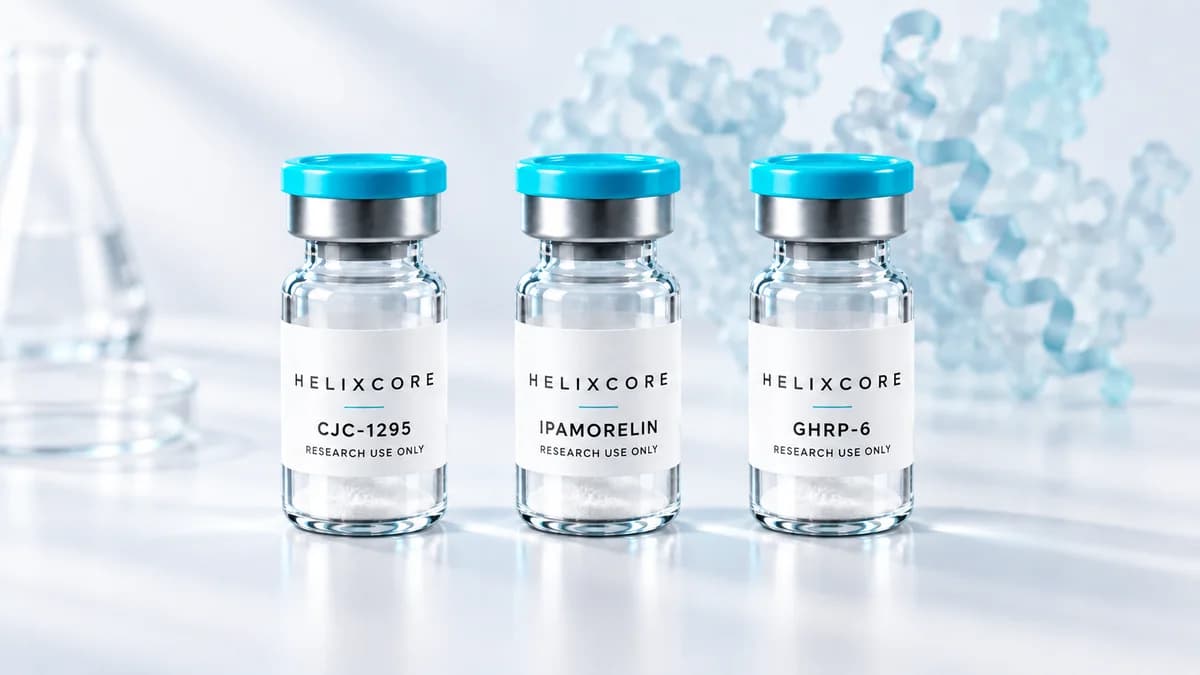
Growth hormone secretagogues are one of the larger families of research peptides — and one where the differences between the named compounds matter at the receptor level. They are often referenced interchangeably as "GHRPs", but receptor selectivity, half-life, and downstream signalling differ enough that the three are not equivalent for in-vitro receptor-modelling work.
This article compares the three most commonly studied: CJC-1295 (no DAC),Ipamorelin, and GHRP-6. A summary table appears at the end.
Two families, one outcome
Growth hormone (GH) release from the pituitary is governed by two independent signalling axes. Understanding which axis a compound acts on is the most important distinction.
GHRH analogues
Growth hormone-releasing hormone is a hypothalamic peptide that binds the GHRH receptor on pituitary somatotrophs and triggers GH release. Synthetic GHRH analogues (like CJC-1295) preserve this pathway.
GHRPs (ghrelin mimetics)
Growth hormone releasing peptides act on a separate receptor (GHS-R1a, the ghrelin receptor). They also trigger GH release but via a different mechanism. Published in-vitro work has reported additive or synergistic effects when GHRH and ghrelin-axis pathways are studied together. Ipamorelin and GHRP-6 are both in this family.
CJC-1295 (no DAC)
Also called Mod GRF (1-29). It's a synthetic fragment of GHRH (amino acids 1 through 29 of the natural hormone) with four amino acid substitutions that protect it from rapid proteolytic degradation. The "no DAC" suffix is important — there's a related compound called CJC-1295 with DAC (Drug Affinity Complex) that has a much longer half-life by binding to albumin. The two have very different pharmacokinetic profiles and should not be confused.
Receptor
GHRH receptor (the GHRH axis).
Half-life
Short — around 30 minutes for CJC-1295 no DAC. The short half-life means receptor occupancy is brief, which preserves pulsatile signalling patterns in models where that matters.
Typical experimental context
Published preclinical work has used CJC-1295 (no DAC) in receptor-binding and pulsatile-release model systems. The short half-life is the distinguishing characteristic versus the longer-acting CJC-1295 with DAC.
Ipamorelin
A synthetic pentapeptide. Ipamorelin is the most receptor-specific of the GHRPs: it acts on GHS-R1a (ghrelin receptor) with high selectivity and very little cross-activity at the receptors that govern cortisol or prolactin release.
Receptor
GHS-R1a (the ghrelin axis).
Half-life
Approximately 2 hours.
Typical experimental context
Published work has used Ipamorelin in receptor-selectivity studies where ghrelin-axis activity is investigated without significant cortisol or prolactin crosstalk. It is the most receptor-specific of the GHRPs in the published literature.
GHRP-6
The oldest of the three — a hexapeptide first reported in the late 1980s. It also acts on GHS-R1a, with less receptor selectivity than Ipamorelin. The published literature notes some cortisol and prolactin crosstalk in animal models, alongside its activity at the ghrelin receptor.
Receptor
GHS-R1a — less selective than Ipamorelin.
Half-life
Short — approximately 15–60 minutes depending on study.
Typical experimental context
GHRP-6 features in the older ghrelin-receptor literature and in comparative studies that include receptor crosstalk as a variable of interest.
At a glance
Reference table. Half-lives are approximate and vary across studies.
- CJC-1295 (no DAC): GHRH receptor · ~30 min half-life · short receptor occupancy
- Ipamorelin: GHS-R1a (selective) · ~2 hr half-life · minimal cortisol/prolactin crosstalk in published models
- GHRP-6: GHS-R1a (less selective) · ~15–60 min half-life · cortisol/prolactin crosstalk reported in published models
Choosing between them for an in-vitro model
Three structural questions usually decide which compound is most relevant for a given experimental design:
- Which receptor pathway is being modelled? GHRH receptor work calls for CJC-1295; ghrelin-receptor work calls for Ipamorelin or GHRP-6. Comparative crosstalk work may use one of each.
- Is receptor selectivity a variable of interest? Ipamorelin is the most receptor-selective in the published literature. GHRP-6 reports broader receptor crosstalk, which can be useful or confounding depending on the question.
- Is pulsatile or sustained receptor occupancy required? Short half-lives preserve pulsatile signalling profiles; the DAC-modified version of CJC-1295 (not stocked here) produces sustained occupancy, which is a different experimental setup entirely.
Specifications & sourcing
All three are typically sold as lyophilised acetate salts. CJC-1295 no DAC and Ipamorelin are commonly available in 2mg and 5mg vials; GHRP-6 in 5mg. 98%+ purity is the standard for research-grade material — anything less can introduce impurity peaks that mess up downstream analytical work.
HelixCore stocks all three: Ipamorelin, CJC-1295 no DAC and GHRP-6. Supplied batch certificates are published on the product pages. Browse the Growth Factor Research category or the CJC-1295 + Ipamorelin research blend.