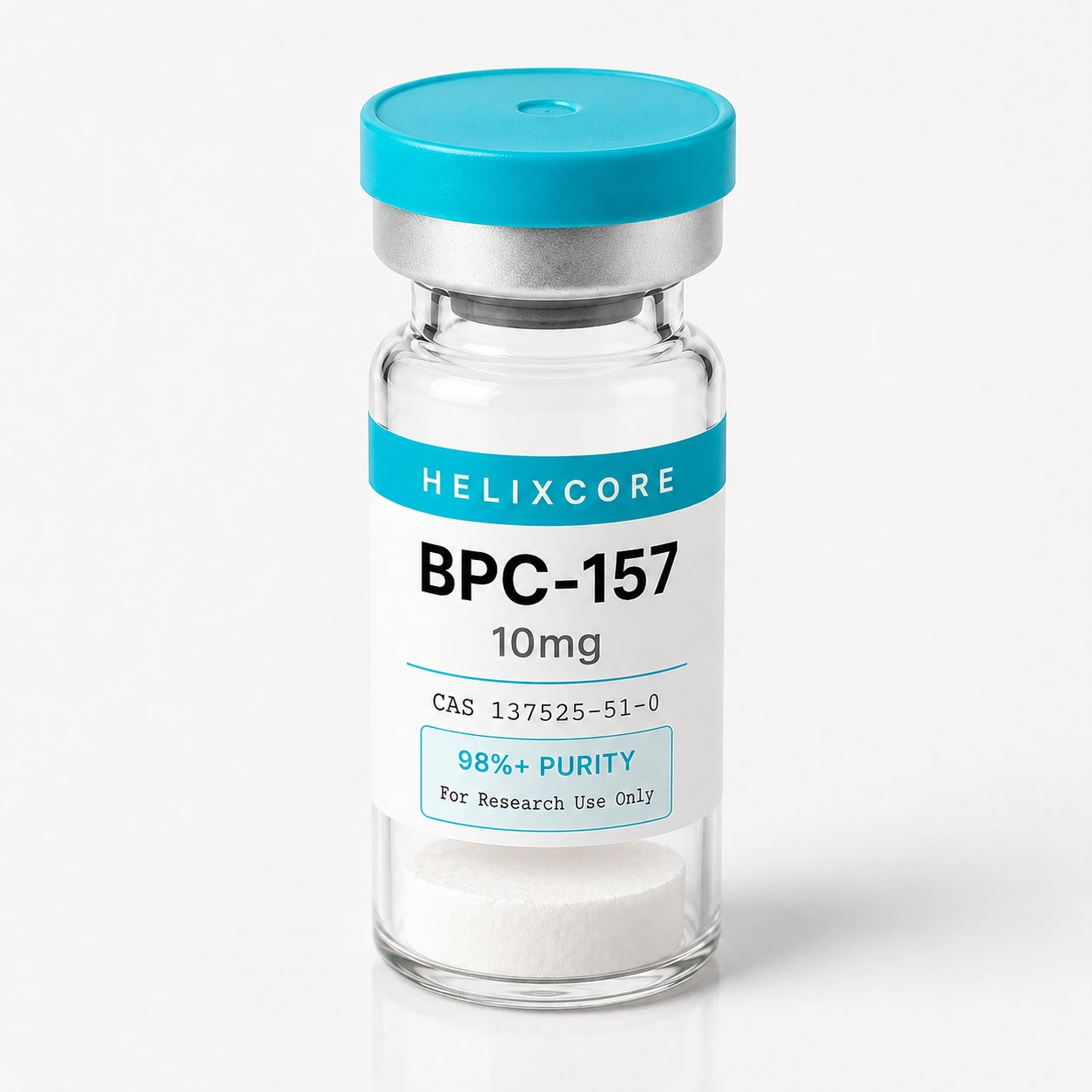
BPC-157
Synthetic pentadecapeptide derived from a human gastric juice protein — supplied for in-vitro research involving peptide stability, cell-signalling, and tissue-model studies.
Purity
98%+ (per source specifications)
Form
Lyophilised Powder
Storage
-20°C lyophilised · store at 2–8°C once reconstituted
CAS Number
137525-51-0
Mol. Weight
1419.53 g/mol
£14.99
Free UK delivery
About BPC-157
What it is
BPC-157 is a synthetic fifteen-amino-acid sequence taken from a larger protein called Body Protection Compound, which was originally identified in human gastric juice. That origin is the interesting part: the parent protein exists in one of the most hostile chemical environments in the body, and the fragment inherits an unusual tolerance of low pH, which is why it is stable in conditions that destroy most peptides.
How it is understood to work
Laboratory work has centred on its interaction with the nitric oxide system and with growth-factor signalling. In cell models it has been observed to influence the expression of vascular endothelial growth factor receptor 2, a receptor central to the formation of new blood vessels, and to affect fibroblast migration — the movement of the cells that lay down collagen. It does not appear to act on a single dedicated receptor of its own, which is part of why it remains of research interest.
What research has looked at
In-vitro and animal-model literature has examined angiogenesis, fibroblast behaviour, tendon and ligament cell cultures, and gastrointestinal mucosal models. Work has also looked at its interaction with the gut-brain axis and with dopaminergic and serotonergic systems. It has not been through human clinical trials to licensing, and no therapeutic use is established or implied here.
Handling and storage
Supplied lyophilised. Stable at -20°C in that form for extended periods; keep it dry and away from light. Once reconstituted with bacteriostatic water, store at 2-8°C and treat it as a short-lived solution — the benzyl alcohol preservative limits microbial growth but does nothing to stop peptide degradation. Avoid repeated freeze-thaw cycles, which fragment the chain.
Supplied for in-vitro laboratory research only. Nothing above describes a dose, a protocol, or a use in humans or animals, and none of these compounds is a licensed medicine in the UK.
Certificate of Analysis
Purity (HPLC)
99.7%
- Batch
- 26061801-03
| Test | Specification | Result |
|---|---|---|
| Appearance | White powder | White powder |
| Identity (mass spectrometry) | 1419.6 ± 1.0 | 1418.9 |
| Purity (HPLC) | Not less than 99.0% | 99.7% |
| Bacterial endotoxins | Not more than 5 EU/mg | Conforms |
| Heavy metals | Not more than 10 ppm | Conforms |
| Water content (Karl Fischer) | Not more than 7.0% | 3.9% |
| Residual solvents | Within limits | Conforms |
This batch of BPC-157 complies with specification. Figures are taken from the manufacturer certificate of analysis for this batch.
Research Information
BPC-157 is studied for its role in tissue research. It's a synthetic 15-amino-acid fragment derived from a protective protein found in human gastric juice, and researchers are interested in how it interacts with growth factor pathways and the formation of new blood vessels (angiogenesis) — the cellular processes by which tissue repairs and rebuilds itself. Most published work has used in-vitro gastrointestinal models and tendon and ligament cell lines to examine these mechanisms.
Research areas
- Tendon and ligament cell-model research
- Angiogenesis and growth factor pathway studies
- Gastrointestinal mucosal cell-line research
- Nitric oxide signalling studies
Analytical methods
Identity and purity are typically confirmed at source by high-performance liquid chromatography (HPLC) and mass spectrometry.
Storage and handling
Store lyophilised at -20°C, away from moisture and direct light. Once reconstituted, store at 2–8°C and use within the timeframe specified on the source datasheet.
For Research Use Only. Not for human or veterinary use.
Batch documentation
Each listed batch includes its supplied certificate of analysis. Published figures are reported per source specifications.
UK dispatch
UK-stocked. Orders placed before 2pm dispatch the same business day via Royal Mail Tracked 24. Free UK shipping on every order. We ship to UK addresses only.