BPC-157: where the research currently stands
A literature-grounded summary of BPC-157 — its origin, sequence, the preclinical research, and the open questions. No claims, just the evidence.
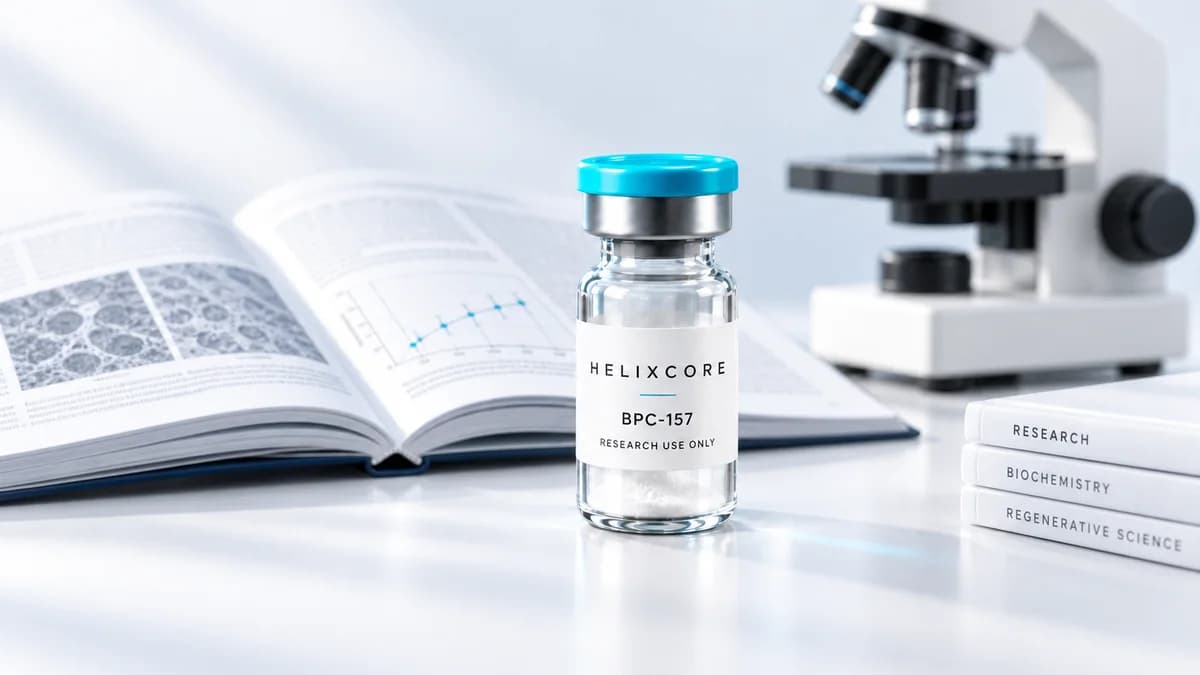
BPC-157 has had a strange research arc. It came out of Croatian gastroenterology in the early 1990s, sat as a niche-but-respectable preclinical curiosity for twenty years, and then in the late 2010s exploded into the wider sports-medicine and biohacker consciousness on the back of a handful of striking rat studies. It now sits somewhere between "genuinely interesting molecule" and "heavily marketed unknown quantity", and the literature reflects both.
This article is a summary of where the actual research stands, not a marketing piece. If you're working with BPC-157 in vitro or in animal models, here's the lay of the land.
What it is
BPC-157 — "Body Protection Compound 157" — is a pentadecapeptide consisting of fifteen amino acids:
Gly-Glu-Pro-Pro-Pro-Gly-Lys-Pro-Ala-Asp-Asp-Ala-Gly-Leu-Val
It was originally isolated as a fragment of a larger protective protein found in human gastric juice. The fragment retained the parent protein's apparent cytoprotective effects on the gastric mucosa, and that's where its name comes from. The synthetic version sold for research is identical to the natural fragment.
Molecular weight is 1419.53 g/mol; CAS number 137525-51-0. It has no known modifications that affect stability — it's a straightforward unmodified peptide.
The mechanistic picture (such as it is)
The mechanism of action is still not fully understood, but several plausible pathways have been investigated:
Nitric oxide signalling
BPC-157 appears to modulate the nitric oxide system, with effects on both endothelial and inducible nitric oxide synthase. This has been one of the more consistent findings across studies.
Growth factor expression
Several rodent studies report upregulation of growth-factor receptors (notably VEGFR2) and downstream angiogenic activity. Whether this is a direct or indirect effect is still debated.
Tendon and ligament fibroblasts
In vitro work on isolated tendon fibroblasts has shown increased migration, survival, and matrix production in the presence of BPC-157. This is the line of research that drove its popularity in sports-medicine circles.
Gut–brain axis
Some of the more recent work explores connections between BPC-157's effects on gut motility and central nervous system outcomes — interesting, but very early.
What's been demonstrated in animal models
The preclinical literature is dominated by rat studies coming out of a small number of European labs. The pattern across these is reasonably consistent:
- Faster tissue-level repair in models of experimentally-induced tendon transections.
- Protective effects against NSAID-induced gastric and intestinal injury.
- Reduced histological damage in models of muscle crush injury.
- Cardioprotective effects in models of cardiac stress.
The effect sizes reported are often large. Some independent groups have reproduced parts of these findings; some have not been replicated outside the original labs. As ever in preclinical work, robustness matters more than headline effect.
What hasn't happened (yet)
Despite the volume of animal data, BPC-157 has not been the subject of large-scale published human clinical trials. There are no Phase II or Phase III registrations on ClinicalTrials.gov as of writing. Until that exists, extrapolations from rodent models to humans should be treated as extrapolations — interesting, but not evidence.
It is not currently licensed as a medicine in the UK, the EU, or the US, and is not on the WADA prohibited list as a specific substance (it could potentially be classed under S0 "non-approved substances" for athletes, but is not named explicitly).
Specifications you'll see
For research use, BPC-157 is typically sold as a lyophilised acetate salt in 5mg or 10mg vials. Storage at −20°C in the lyophilised form is stable for long periods; once reconstituted, 2–8°C and use within 2-4 weeks. Acetate content is usually 10–15% of total mass — relevant if you're calculating net peptide for an in-vitro protocol.
Open questions worth following
- How much of the rat-tendon literature replicates in independent labs with pre-registration?
- What is the actual receptor? The candidates so far are all indirect.
- Does the oral form (if a stable one exists) have meaningfully different pharmacokinetics from injected?
- Are the angiogenic effects on intact, non-injured tissue zero, or just smaller? Important question for any human translation.
Bottom line
BPC-157 is one of the more studied synthetic peptides in the preclinical literature — there is a measurable signal in the published rodent data and a plausible mechanistic story. It is also one of the most over-claimed compounds in the wider supplement and biohacking discourse, and the gap between what rodent studies report and what could be inferred for humans remains wide. Published independent replications, especially with pre-registration, are the next thing the literature needs.
HelixCore stocks BPC-157 in 5mg and 10mg vials, 98%+ purity per source specifications. The supplied batch certificate is published on the product page. UK stock, Royal Mail Tracked 24 dispatch. See also the BPC-157 vs TB-500 comparison.