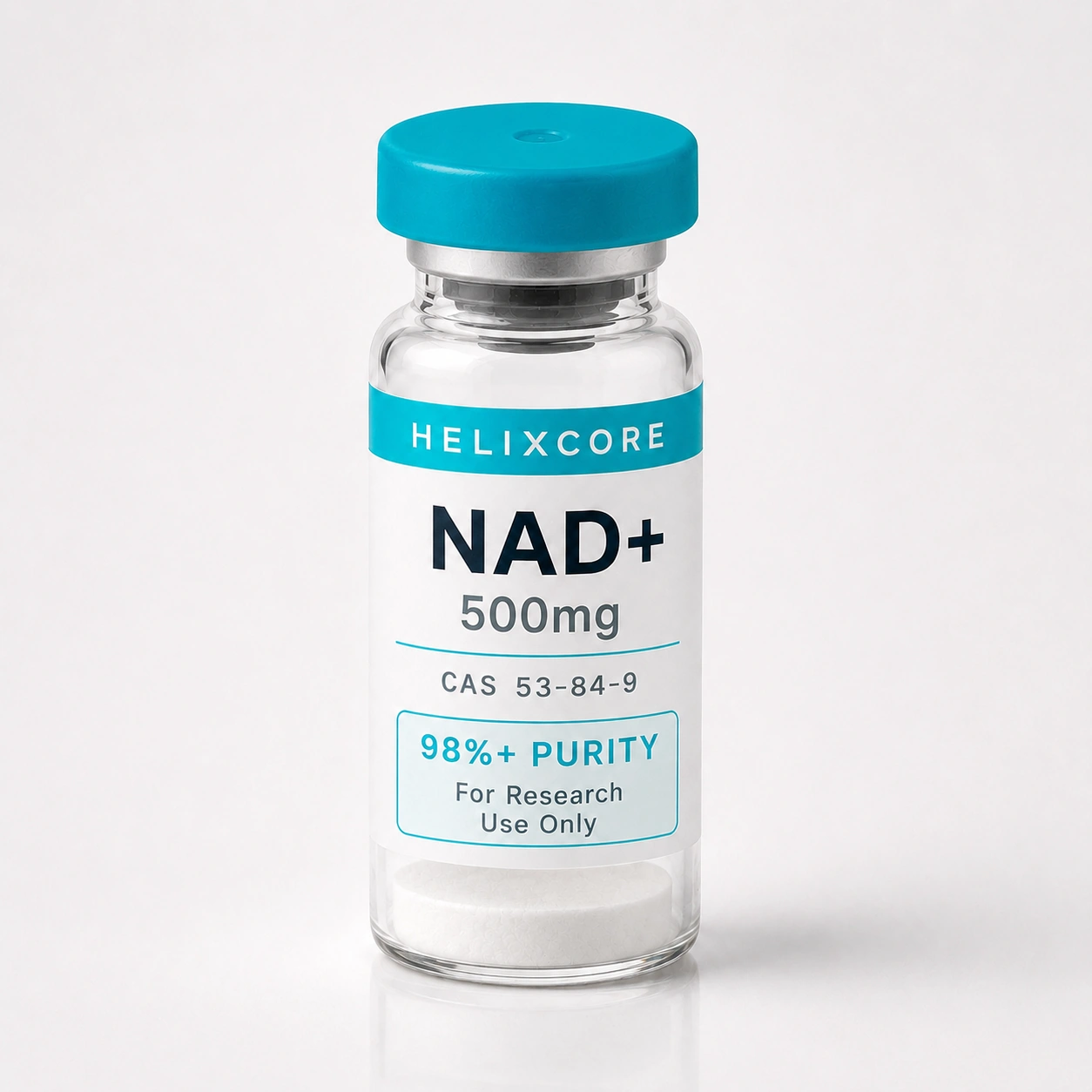
NAD+
Nicotinamide adenine dinucleotide supplied for in-vitro cellular metabolism research.
Purity
98%+ (per source specifications)
Form
Lyophilised Powder
Storage
-20°C lyophilised · store at 2–8°C once reconstituted
CAS Number
53-84-9
Mol. Weight
663.4 g/mol
£64.99
Free UK delivery
About NAD+
What it is
NAD+ is nicotinamide adenine dinucleotide, a coenzyme present in every living cell. It is not a peptide and not a novel research compound — it is one of the most fundamental molecules in metabolism, which is precisely why it appears here.
How it is understood to work
It works as an electron carrier, cycling between the oxidised NAD+ and reduced NADH forms to shuttle reducing equivalents through glycolysis, the citric acid cycle and oxidative phosphorylation. Separately, it is consumed as a substrate rather than recycled by two important enzyme families: the sirtuins, which deacetylate proteins including histones, and the PARPs, which respond to DNA damage. That consumption is why cellular NAD+ availability is a live research question rather than a settled one.
What research has looked at
Cellular metabolism, sirtuin activity, DNA damage response, and mitochondrial function. Declining NAD+ availability with age is a substantial and active area of research.
Handling and storage
Unstable in solution, and more so at neutral or alkaline pH. Prepare fresh where the protocol allows, keep cold, and protect from light. Do not assume it behaves like the peptides in this catalogue.
Supplied for in-vitro laboratory research only. Nothing above describes a dose, a protocol, or a use in humans or animals, and none of these compounds is a licensed medicine in the UK.
Certificate of Analysis
Purity (HPLC)
99.2%
- Batch
- 26032501
| Test | Specification | Result |
|---|---|---|
| Appearance | White to yellowish powder | White powder |
| Identity (mass spectrometry) | 663.4 ± 1.0 | 663.0 |
| Purity (HPLC) | Not less than 95.0% | 99.2% |
| Assay of β-NAD | Not less than 90.0% | 99.0% |
| Bacterial endotoxins | Less than 1 EU/mg | Less than 0.2 EU/mg |
| Heavy metals (Pb, As, Hg, Cd) | Within limits | Not detected |
| Water content | Not more than 5.0% | 4.8% |
This batch of NAD+ complies with specification. Figures are taken from the manufacturer certificate of analysis for this batch.
Research Information
NAD+ (Nicotinamide Adenine Dinucleotide) is a coenzyme present in every cell, central to over 400 metabolic reactions, studied for its role in cellular energy and ageing research. NAD+ levels decline with age in cell-culture studies, prompting research into how restoring intracellular NAD+ affects sirtuin enzyme activity, mitochondrial function, and DNA repair pathways. Most published work has used cell lines and tissue models to examine NAD+ precursor metabolism and the sirtuin and PARP signalling axes.
Research areas
- Sirtuin enzyme activity studies
- Mitochondrial NAD+ metabolism research
- DNA repair pathway (PARP) studies
- Cellular bioenergetics models
Analytical methods
Identity and purity are typically confirmed at source by high-performance liquid chromatography (HPLC) and mass spectrometry.
Storage and handling
Store lyophilised at -20°C, away from moisture and direct light. Once reconstituted, store at 2–8°C and use within the timeframe specified on the source datasheet.
For Research Use Only. Not for human or veterinary use.
Batch documentation
Each listed batch includes its supplied certificate of analysis. Published figures are reported per source specifications.
UK dispatch
UK-stocked. Orders placed before 2pm dispatch the same business day via Royal Mail Tracked 24. Free UK shipping on every order. We ship to UK addresses only.