NAD+ in research: metabolism, ageing and the salvage pathway
What NAD+ is, why it is central to metabolism and sirtuin/PARP signalling, the salvage pathway and its precursors NMN and NR, where the ageing research focus sits, and the delivery problem that shapes the field.
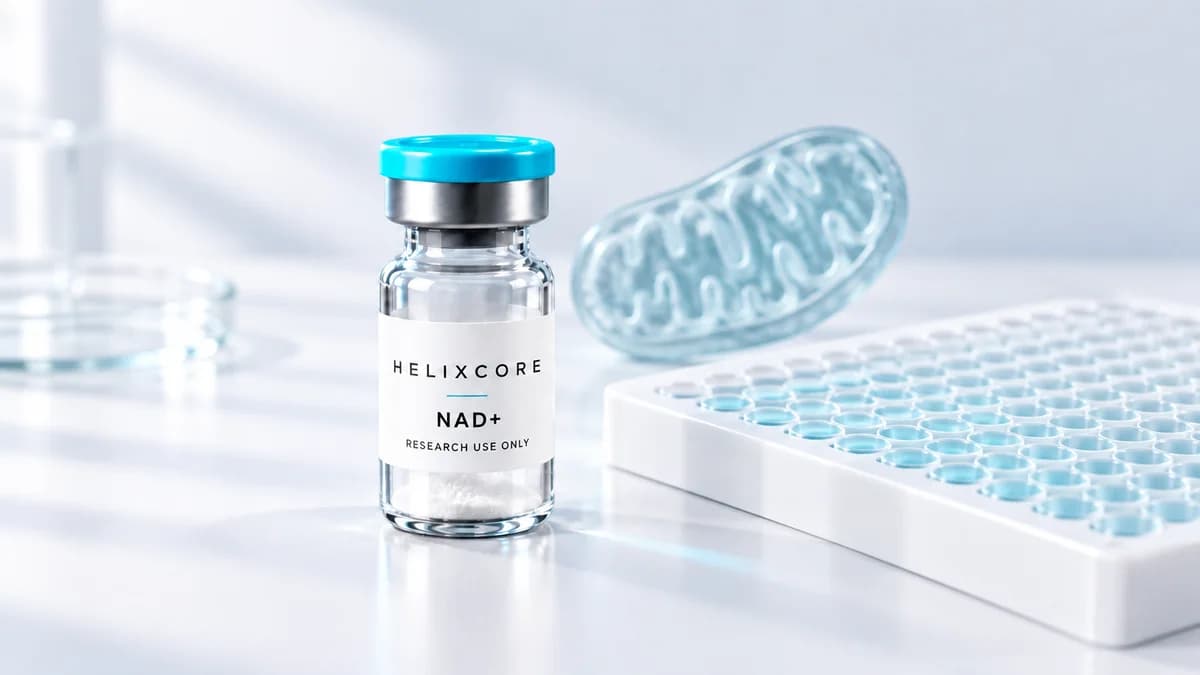
NAD+ occupies an unusual place in the research-compound world. Unlike most peptides, it is not obscure at all — it is one of the most fundamental molecules in cell biology, present in every living cell, and taught in first-year biochemistry. What is newer is the wave of research into what happens when its levels decline, and whether raising them changes anything measurable. This is a summary of the actual science, kept firmly on the research side of the line.
What it is
NAD+ — nicotinamide adenine dinucleotide — is a coenzyme found in all cells. It is not a peptide; it is a dinucleotide, built from two nucleotides joined through their phosphate groups. Its CAS number is 53-84-9 and its molecular weight is 663.43 g/mol. It is grouped with research peptides commercially because it is handled the same way in the lab: a lyophilised compound reconstituted for in-vitro work.
Why it matters biologically
Redox reactions
NAD+ and its reduced form NADH are the central electron carriers of metabolism. They shuttle electrons through glycolysis, the citric acid cycle and oxidative phosphorylation — in other words, they sit at the heart of how cells extract energy from nutrients. This role is textbook and beyond dispute.
Signalling and enzyme cofactor roles
Beyond energy metabolism, NAD+ is consumed as a substrate by several important enzyme families, notably the sirtuins (SIRT1–7) and the PARPs (poly-ADP-ribose polymerases). Because these enzymes use NAD+ up rather than merely borrowing it, cellular NAD+ has to be continuously regenerated. This consumption is the mechanistic hook for much of the ageing-and-metabolism research.
The salvage pathway and precursors
Cells maintain NAD+ largely through the salvage pathway, which recycles nicotinamide back into NAD+ via intermediates including NMN (nicotinamide mononucleotide) and NR (nicotinamide riboside). Much of the applied research in this area has focused on these precursors rather than on NAD+ itself, precisely because they are smaller and, in principle, easier to deliver into cells. Any serious reading on NAD+ research quickly becomes a reading on NMN and NR as well.
Where the research focus sits
The current research interest clusters around a single observation: tissue NAD+ levels appear to decline with age across many organisms studied, and a number of age-associated metabolic changes track that decline. This has driven a large body of in-vitro and animal work asking whether restoring NAD+, or supplying its precursors, alters those changes. Reported findings in model systems include effects on mitochondrial function, DNA-repair activity (via PARPs) and sirtuin-dependent processes.
What must be stated plainly is that this is an active, unsettled research area. The animal and cell data are genuinely interesting; the human clinical picture is early and far less clear-cut, and results in model organisms have repeatedly failed to translate directly to humans in this field. Extrapolations from a mouse study to human outcomes are extrapolations, not evidence.
The delivery problem
A recurring theme in NAD+ research is that the molecule is large, charged and does not cross cell membranes easily. This is a large part of why the precursors NMN and NR receive so much attention, and why routes of administration are a live methodological question in the literature rather than a solved detail. For in-vitro research the delivery question is handled experimentally; it is mentioned here because it is central to understanding why the field looks the way it does.
Specifications you will see
For research use, NAD+ is typically supplied as a lyophilised powder in higher masses than most peptides — 500mg vials are common, reflecting its lower potency by mass and its different role. Colour can range from off-white to a pale yellow depending on batch and form. Store cold and dry; reconstitute per protocol and use promptly. See our storage guide for handling detail.
Bottom line
NAD+ is not a fringe molecule — its metabolic role is as established as biochemistry gets. The genuinely open questions are downstream: whether age-related NAD+ decline is a cause or a consequence, whether raising NAD+ or its precursors changes meaningful outcomes, and whether any of the striking model-organism results hold up in humans. It is a legitimately interesting research target precisely because those questions are unresolved.
HelixCore stocks NAD+ in 500mg vials, 98%+ purity per source specifications. The supplied batch certificate is published on the product page. UK stock, Royal Mail Tracked 24 dispatch, supplied strictly for in-vitro laboratory research use only — not for human or veterinary use.