Buying research peptides in the UK: the legal landscape explained
Where research peptides sit in UK law, what "Research Use Only" actually means, who can purchase, and what to look for in a UK supplier. Practical orientation for researchers.
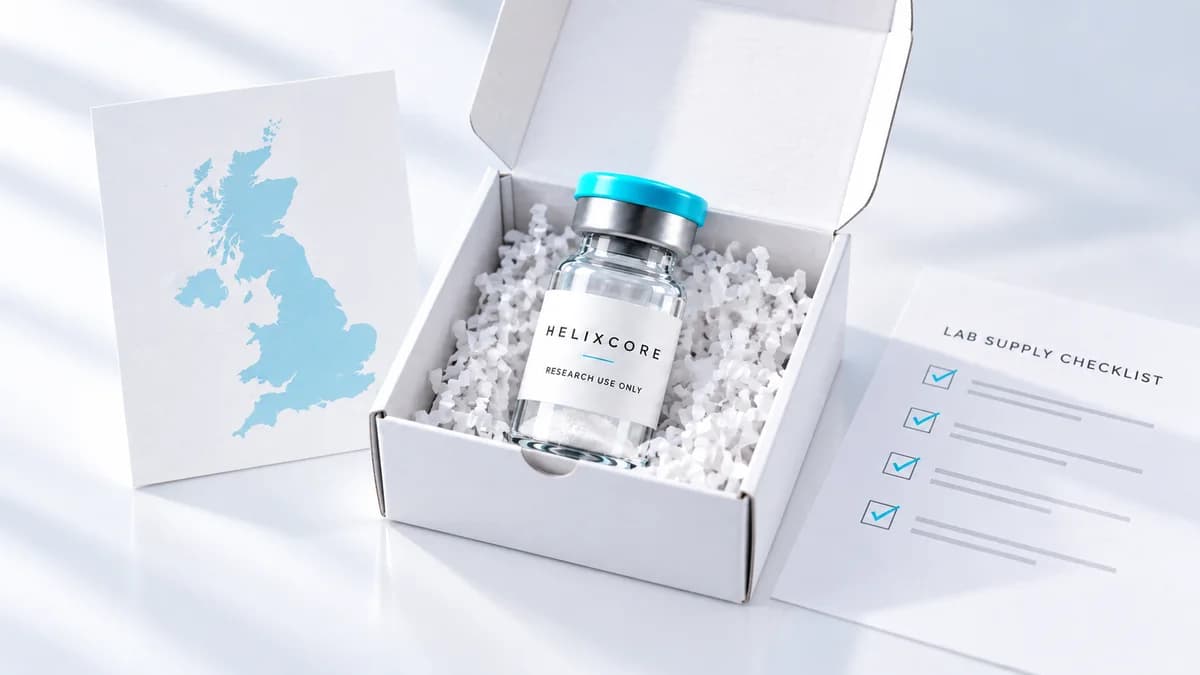
Buying research peptides as a UK-based researcher is more complicated than ordering reagents through Sigma-Aldrich, but it's less complicated than the market's often-confusing language suggests. This article lays out the actual regulatory landscape, the practical questions buyers should ask, and what to look for in a UK supplier.
Nothing here is legal advice. This is a practical orientation written for researchers and laboratory staff working in legitimate research settings.
Where research peptides sit in UK law
Research peptides — synthetic peptides supplied for in-vitro laboratory research — sit in a specific regulatory category. They are not:
- Licensed medicinal products under the Human Medicines Regulations 2012 (no MHRA marketing authorisation)
- Veterinary medicinal products under the Veterinary Medicines Regulations 2013
- Food supplements or novel foods under retained EU Regulation 2015/2283
- Controlled substances under the Misuse of Drugs Act 1971 (with rare exceptions where specific peptides have been scheduled)
- Psychoactive substances under the Psychoactive Substances Act 2016 (most research peptides do not produce a "psychoactive effect" as legally defined)
They are supplied as research chemicals for in-vitro laboratory work. The supplier is selling a research material; the buyer is responsible for how it is used.
This is the same regulatory category Sigma-Aldrich (now Merck) operates in for thousands of research reagents, including many peptides. The difference is that research peptide retailers operate at lower order volumes and with a buyer population that includes individual researchers rather than only institutions.
What "research use only" actually means
"Research Use Only" (RUO) is a regulatory designation. It means the compound:
- Has not been evaluated by a medicines regulator for safety or efficacy in humans
- Cannot legally be sold for human or veterinary administration
- Is intended for laboratory research — typically in-vitro work, cell-culture studies, or properly licensed animal-model work
A supplier selling under RUO labelling is operating within established UK regulatory norms. Buyers using the products outside the RUO scope are operating outside it, and that's a buyer-side responsibility — not the supplier's decision to police on a case-by-case basis.
Who can legally purchase research peptides in the UK
Most reputable UK suppliers ask buyers to confirm at the point of order that they are:
- Aged 18 or over
- A qualified researcher, scientist, or licensed professional working in an appropriate setting
- Purchasing solely for legitimate in-vitro laboratory research
- Aware that the products are not for human or veterinary consumption
- Responsible for compliance with all local laws regarding storage, handling, and disposal
This isn't bureaucratic theatre. The eligibility confirmation creates a documented framework that defines the supply relationship as legitimate research-chemical commerce.
What to look for in a UK supplier
UK stock, not drop-shipping
A meaningful distinction. Some suppliers list as "UK" but actually drop-ship from US or Chinese inventory — your order is processed in the UK but the parcel originates from overseas. This means customs delays, the risk of seizure (HMRC sometimes intercepts grey-area shipments), and longer lead times.
Genuine UK stock means the supplier has imported and warehoused the inventory in the UK in advance, and your order ships from a UK address. Royal Mail Tracked 24 dispatch is a strong signal.
Third-party batch testing
Research peptides are synthesised by specialist contract manufacturers, mostly in China and India, with quality varying significantly between suppliers. The good supply chains routinely send representative samples of every batch to independent analytical labs for HPLC purity confirmation and mass spectrometry identity confirmation, before the batch is released to commercial customers.
A supplier saying "third-party batch tested" without naming the lab or describing the process is making a marketing claim. A supplier describing the actual process — and making batch documentation available to qualified institutional buyers — is communicating something real.
See our guide to what good batch testing documentation looks like for what to actually look for.
Transparent pricing
UK research peptide pricing varies by 30–40% across the market for the same compound. Some of that reflects genuine differences in batch quality and stock levels; some of it reflects what the supplier thinks buyers will pay. Comparing 3–4 UK suppliers on the same compound before ordering is normal.
A documented research-use policy
A legitimate UK supplier should have a published research-use policy, terms of service, and clear age and purpose verification at checkout. Suppliers that skip these signals are usually skipping them for a reason.
Common buyer questions
Will customs hold my order?
Orders shipping from genuine UK stock to UK addresses don't pass through customs — there's no border crossing. Orders shipping from overseas sometimes do, particularly larger orders where HMRC may query whether the shipment includes medicinal products. Sticking to genuine UK-stocked suppliers eliminates that risk.
Is the supplier's product different from the version other shops sell?
Most UK research peptide retailers source from a relatively small number of Chinese contract manufacturers. The differentiator isn't usually the compound itself — it's the batch testing rigour, the stock conditions, and the speed of UK fulfilment.
Can I get test reports for what I bought?
Practice varies. Some suppliers publish redacted batch test reports publicly; others hold documentation internally and make it available to verified institutional buyers on request. A supplier that refuses any verification — even to a named institutional researcher with an order reference — is one to question.
What about VAT?
UK retailers with under £85,000 annual turnover (the current VAT registration threshold) don't charge VAT. Larger retailers do. This shows up in pricing comparisons — a £30 price from a non-VAT-registered seller is genuinely £30; a £30 price from a VAT-registered seller is £25 net + £5 VAT.
Bottom line
Buying research peptides as a UK-based researcher is a normal commercial transaction within an established regulatory framework. The legal landscape is well-defined: research chemicals sold for in-vitro use under the RUO designation, with buyer-side eligibility confirmation.
The differentiators between suppliers are practical: UK stock vs. drop-shipping, batch testing rigour, transparent terms, fulfilment speed, and pricing. Those are the things worth comparing before placing an order.
HelixCore is a UK-based supplier of research compounds — peptides, small molecules, and laboratory solutions. Supplied batch certificates are published with figures reported per source specifications. UK-stocked, dispatched same business day via Royal Mail Tracked 24. Browse the full catalogue, or go straight to the most commonly ordered compounds: BPC-157, TB-500, GHK-Cu, Ipamorelin and bacteriostatic water.